
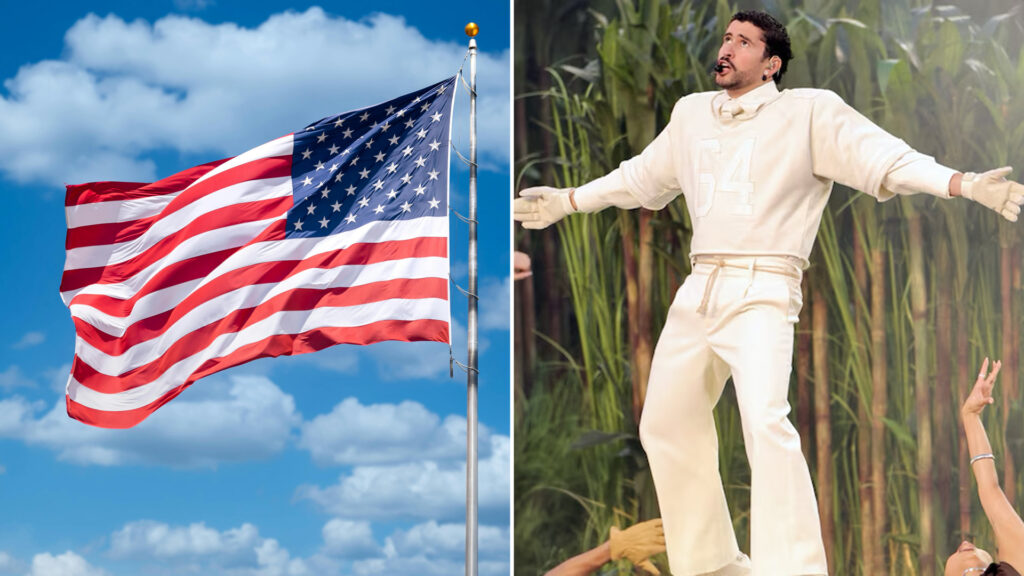
The 68th Annual Grammy Awards were supposed to be Billie Eilish’s victory lap. Instead, they became a reckoning—for the industry and its relationship with one of its biggest stars.
In a shocking move that has sent ripples through pop culture, the Recording Academy announced this morning that it had rescinded Eilish’s Song of the Year award for “Wildflower” and issued a permanent, lifetime ban. The official statement was blunt and personal: “You’re no more welcome here.”
But as the dust settles on what might be the most chaotic 24 hours in music history, one question lingers: Did Billie Eilish break the Grammys, or did she merely expose how fragile they always were?
The drama all started in the three minutes before the ban. When Billie took the stage, she wore none of the usual “happy to be here” polish. Clad in a vintage oversized suit adorned with a bold “ICE Out” emblem, she ignored agents, PR handlers, and the usual script.
Instead, she delivered what the Academy called a “brutal” critique of the current political climate, targeting federal immigration agencies and the silence of the billionaire class. Her words were raw, profanity-laced, and broadcast to millions.
When technical glitches cut her audio for the third time, Billie leaned into the mic and addressed the front row directly: “You want our art, but you don’t want our voices. You want the numbers, but you don’t want the truth.”
The Academy’s response was swift and severe. Rumors suggest a midnight emergency session of the Board of Governors. By 8:00 AM, Eilish’s award was rescinded, and her lifetime ban was confirmed.
By stripping her of the trophy, the Academy didn’t just reclaim a gold-plated gramophone—they attempted to erase her from its history. Banning an artist of Eilish’s stature—a woman who has carried the industry’s relevance for the last seven years—was a move so audacious it felt antiquated.
The phrase “You’re no more welcome here” was not policy—it was a statement. It was a gatekeeping institution slamming the door on the very person who helped keep it profitable.
The fallout is polarizing. One side, the “Shut Up and Sing” crowd, argues that the Grammys are for craft, not political statements. For them, Eilish’s critique was a breach of the unspoken celebrity social contract.
On the other side are fans and fellow artists who see this as corporate censorship. If the Grammys can erase Billie Eilish for speaking her mind, who is safe? Protest is now a breach of contract? The irony: the music industry commodifies rebellion, yet punishes it when it’s real.
Here’s what the Academy seems to have forgotten: Billie Eilish doesn’t need the Grammys. The Grammys need Billie Eilish.
In an era of streaming and direct-to-fan engagement, awards are optional. You can take the trophy, but you can’t take the billions of streams. You can ban her from the stage, but not from the playlists of millions.
In trying to make an example of her, the Academy has created a martyr for artistic freedom. They wanted to silence a controversial voice—they’ve amplified it tenfold.
Already, the “Eilish Effect” is in motion. Rumors suggest major labels may boycott the 2027 ceremony in solidarity. If the Grammys become a showcase for only “safe” artists, they will stop reflecting music and start reflecting PR strategies.
The Academy thinks it ended a controversy. In reality, it started a war.
Billie Eilish may no longer be “welcome” in their hall, but history is often written by those who were kicked out of the room. She’ll be fine. The question is: will the Grammys?