
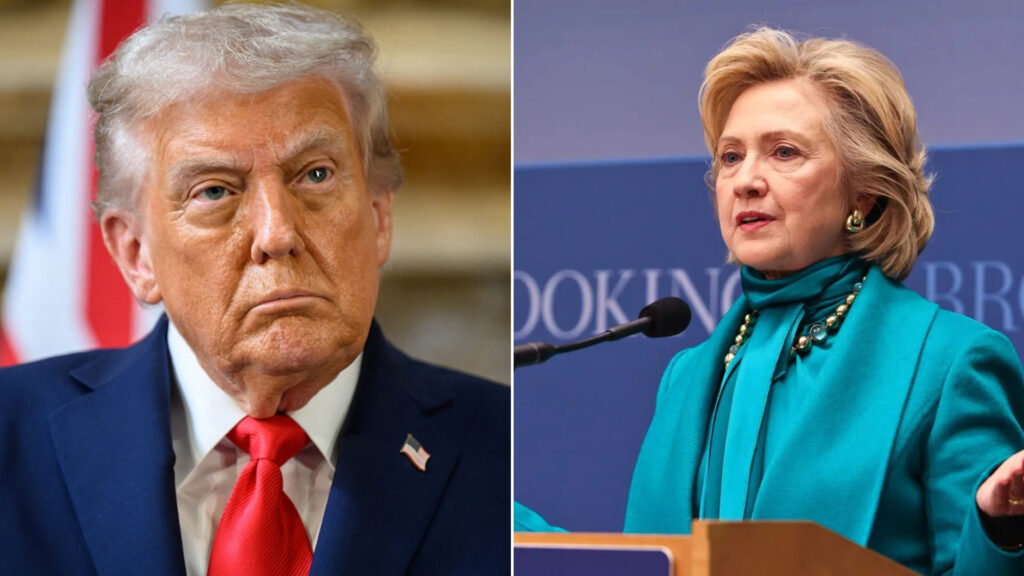
On April 26, 2016, Donald Trump stood before his supporters after sweeping five Republican primaries and turned his attention to Hillary Clinton.
“I think the only card she has is the woman’s card,” he said. “She’s got nothing else going. And frankly, if Hillary Clinton were a man, I don’t think she’d get five percent of the vote.”
That night, in Philadelphia, Clinton responded.
“Mr. Trump accused me of playing the, quote, ‘woman card,'” she told her supporters. “Well, if fighting for women’s health care and paid family leave and equal pay is playing the woman card—then deal me in.”
Within forty-eight hours, her campaign had raised $2.4 million. They printed actual pink “Woman Cards” and sold them to donors. “Deal me in” became a rallying cry that followed her all the way to the convention.
But the story behind that moment—the story of how Hillary Rodham Clinton became the woman standing on that stage—stretches back decades. And it begins not with politics, but with children.
Hillary Diane Rodham was born on October 26, 1947, in Chicago, Illinois. Her father, Hugh Rodham, ran a small textile business. Her mother, Dorothy, had survived a childhood of abandonment and neglect that would later shape Hillary’s understanding of what happens to children when systems fail them.
The Rodhams moved to the suburb of Park Ridge when Hillary was three. She grew up in a household that emphasized hard work, academic excellence, and the conviction that a girl could do anything a boy could do.
At Wellesley College, she arrived as a Republican—president of the campus Young Republicans club. But the assassinations of Martin Luther King Jr. and Robert Kennedy, the Vietnam War, and the civil rights movement transformed her politics. By the time she graduated in 1969, she had become a Democrat.
Her commencement speech made national news. She was the first student in Wellesley’s history to speak at graduation—and she used the platform to challenge a sitting U.S. Senator who had spoken before her. Life magazine featured her afterward.
Then she went to Yale Law School. And there, she found her cause.
In 1970, Marian Wright Edelman—a civil rights lawyer who had become the first Black woman admitted to the Mississippi Bar—spoke to Hillary’s law school class. Edelman had just founded what would become the Children’s Defense Fund, an organization dedicated to advocating for children who had no political power and no voice.
For Hillary, it was a turning point. “Until I heard Marian speak,” she later said, “it wasn’t clear to me how to channel my faith and commitment to social justice to try to make a real difference in the world.”
After graduating from Yale in 1973, Hillary didn’t take the path most of her classmates chose. She didn’t join a corporate law firm. Instead, she went to work for Marian Wright Edelman at the Children’s Defense Fund.
Her first assignment: figure out why nearly two million American children weren’t in school.
Hillary went door to door. She found children with disabilities—blindness, deafness, physical limitations—who had been told they couldn’t attend public schools. She found children caring for younger siblings while their parents worked. She found a girl in a wheelchair who told her how desperately she wanted to learn.
The report that emerged from this research—”Children Out of School in America”—became a catalyst for one of the most important pieces of education legislation in American history: the Education for All Handicapped Children Act, now known as the Individuals with Disabilities Education Act. For the first time, children with disabilities had a federal right to a free public education.
Hillary Rodham was twenty-six years old.
In 1974, she took a detour. The House Judiciary Committee was investigating whether to impeach President Richard Nixon over Watergate. Hillary joined the impeachment inquiry staff, advising the committee on constitutional law.
When Nixon resigned, she faced a choice. She had job offers from prestigious law firms and advocacy organizations across the East Coast. Instead, she moved to Arkansas.
Bill Clinton—the Yale Law classmate she had met in the library, the man who kept staring at her until she walked over and introduced herself—was building a political career in his home state. Hillary followed. They married in 1975.
For the next seventeen years, Hillary lived in Arkansas. She taught at the University of Arkansas Law School. She founded the state’s first legal aid clinic. She co-founded Arkansas Advocates for Children and Families. She served on the board of the Children’s Defense Fund and eventually became its chairman.
When Bill Clinton became governor, she chaired the Arkansas Education Standards Committee and fought to improve the state’s schools. She joined the Rose Law Firm, becoming one of the most influential lawyers in the state—named twice to the National Law Journal’s list of the 100 most powerful lawyers in America.
And through all of it, she kept working on children’s issues. Her 1973 article “Children Under the Law,” published in the Harvard Educational Review, became one of the foundational texts of the children’s rights movement.
In 1992, Bill Clinton was elected president. Hillary became First Lady—and immediately broke the mold.
She took an office in the West Wing, among the president’s senior staff. No First Lady had ever done that. She led the administration’s task force on health care reform—an ambitious attempt to guarantee universal coverage that ultimately failed in Congress. Critics called her overreaching. Supporters called her ahead of her time.
[In the historical record: The Children’s Health Insurance Program, which Hillary championed after the larger health care effort failed, eventually provided coverage to millions of children.]
She traveled to Beijing in 1995 for the United Nations Fourth World Conference on Women and delivered words that would echo around the world: “Human rights are women’s rights, and women’s rights are human rights.”
She was investigated. She was mocked. She was blamed for her husband’s infidelities. She was accused of everything from financial impropriety to murder. She became, for millions of Americans, a symbol of everything they feared about feminism, ambition, and changing gender roles.
She kept going.
In 2000, Hillary Clinton did something no First Lady had ever done: she ran for office.
She won the U.S. Senate seat from New York, becoming the first First Lady ever elected to public office. She was reelected in 2006. After September 11, 2001, she secured funding to rebuild New York and provide health care for first responders. She worked across party lines on veterans’ issues and economic development.
In 2008, she ran for president. She won more primaries than any woman in American history. She came closer to the nomination than any woman ever had. But she lost to Barack Obama.
“Although we weren’t able to shatter that highest, hardest glass ceiling this time,” she told her supporters, “thanks to you, it’s got about 18 million cracks in it.”
Obama appointed her Secretary of State. For four years, she served as America’s chief diplomat, visiting 112 countries, negotiating with allies and adversaries, representing the United States on the world stage.
Then, in 2015, she announced she would run for president again.
The 2016 campaign was brutal in ways that surprised even veteran observers.
Donald Trump called her “Crooked Hillary.” He led chants of “Lock her up.” He brought women who had accused her husband of misconduct to a debate. He questioned her “stamina.” He said she didn’t have “a presidential look.”
And he accused her of playing the woman card.
The criticism wasn’t new. Throughout her career, Hillary Clinton had been called too ambitious, too calculating, too cold, too emotional, too aggressive, too accommodating. She had been told she smiled too much and not enough. She had been told her voice was too shrill, that she “shouted” her speeches. She had been asked why she didn’t leave her husband. She had been asked why she stayed.
What was new was how she responded.
“Deal me in.”
On July 26, 2016, at the Democratic National Convention in Philadelphia, Hillary Clinton officially became the first woman ever nominated for president by a major American political party.
“When there are no ceilings,” she said in her acceptance speech, “the sky’s the limit.”
She won the popular vote by nearly three million votes—more than any losing candidate in American history. But she lost the Electoral College. Donald Trump became president.
The morning after the election, Hillary Clinton gave her concession speech.
“I know we have still not shattered that highest and hardest glass ceiling,” she said, “but someday, someone will, and hopefully sooner than we might think right now.”
To every little girl watching, she added: “Never doubt that you are valuable and powerful and deserving of every chance and opportunity in the world to pursue and achieve your own dreams.”
Since 2016, Hillary Clinton has written books, launched a political action organization, started a podcast, and founded a production company. She became Chancellor of Queen’s University Belfast. She joined Columbia University as a professor.
She has not disappeared. She has not stopped speaking. She has not apologized for being ambitious.
In 2024, eight years after her defeat, Kamala Harris became the second woman nominated for president by a major party—standing on the path Hillary Clinton had helped clear.
The woman card didn’t win in 2016. But it’s still in play.
Hillary Rodham Clinton spent fifty years walking into rooms where no woman had stood before. She knocked on doors for children who couldn’t speak for themselves. She testified before Congress, negotiated with world leaders, and debated men who told her she didn’t belong on the stage.
They called her too much of everything.
She showed up anyway.
That’s the hand she played. And for every woman still playing against the odds, it’s the hand she dealt them too.