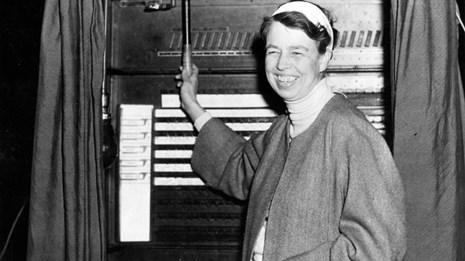
Eleanor Roosevelt was born into one of America’s most privileged families, but privilege couldn’t protect her from cruelty that lived inside her own home. Her mother, Anna Hall Roosevelt, was a celebrated beauty—elegant, admired, the kind of woman who commanded rooms effortlessly. And she looked at her daughter Eleanor with visible disappointment. “Granny,” she called her. Not as a term of endearment, but as a weapon—a constant reminder that Eleanor was awkward, plain, unworthy of love. The nickname was designed to make sure Eleanor never forgot she wasn’t enough. Eleanor absorbed that lesson deeply. She learned to make herself small, to apologize for existing, to believe the cruelty directed at her. Her father, Elliott Roosevelt, was different. He adored her unconditionally, saw her intelligence and sensitivity as gifts rather than flaws. When he held her, she felt safe. When he spoke to her, she felt valuable.Then he died from alcoholism before she turned ten.The one person who had loved her completely was gone. And Eleanor was left with the echoing message: you are not lovable. Most people who grow up with that kind of pain spend their lives either hardening against it or being destroyed by it. Eleanor chose a third path: she let it break her open. She learned that suffering, faced honestly, could become compassion. That pain could teach you to see other people’s pain. That being underestimated could become a kind of freedom—because when no one expects anything from you, you can do everything.Years later, she would distill that hard-won wisdom into a sentence that still echoes: “No one can make you feel inferior without your consent. “But first, she had to live it.When Franklin Roosevelt became president in 1933, the nation was collapsing under the Great Depression. Her husband governed from a wheelchair, paralyzed from polio. And Washington had very specific expectations for the First Lady: host elegant dinners, smile graciously, remain decorative and silent. Eleanor Roosevelt refused. In her first year alone, she traveled more than forty thousand miles—more than any First Lady before her. But she didn’t visit palaces or attend diplomatic galas. She went to coal camps in Appalachia, where miners lived in company-owned shacks without running water. She went to sharecropper cabins in the South, where Black families lived in conditions that made slavery feel uncomfortably recent. She went to prisons, hospitals, Indian reservations, schools without books or heat.She traveled alone, usually without advance notice, carrying only a notebook and her relentless questions: What do you need? What isn’t working? What does Washington refuse to see? When society reporters mocked her for visiting coal camps instead of hosting elegant parties, she answered without bitterness: “I prefer being where the problems are, not where the cocktails are. “She used her position to create pressure. Every day, she wrote “My Day,” a newspaper column that reached millions of Americans. It wasn’t gossip or society fluff. It was a moral ledger—recording what she’d seen, what needed to change, what the country needed to face about itself. During World War II, she crossed oceans to visit wounded soldiers. She sat on their bunk beds and listened to their stories. She wrote letters by hand to grieving families. Military officials urged her to skip segregated Black units—too controversial, they said.She insisted on visiting them anyway.She spoke openly about civil rights when doing so risked destroying her husband’s political coalition. When the Daughters of the American Revolution refused to allow Marian Anderson—a world-renowned Black opera singer—to perform at Constitution Hall because of her race, Eleanor didn’t argue quietly behind closed doors. She resigned from the organization publicly. Then she helped arrange a concert on the steps of the Lincoln Memorial.On April 9, 1939, seventy-five thousand people gathered. Black and white. Young and old. Rich and poor. Marian Anderson stood beneath Abraham Lincoln’s statue and sang “My Country, ‘Tis of Thee” with a voice so powerful it seemed to crack history itself.It wasn’t just a performance. It was a declaration. Eleanor wrote later that democracy wasn’t proven by words, but by choices. Either you defended its principles when it was difficult, or you only pretended to believe in them. When Franklin died in 1945, the world assumed Eleanor would fade into private grief, quietly disappearing into widowhood like First Ladies before her. She did the opposite.President Truman appointed her to the newly formed United Nations delegation. Many diplomats dismissed her as a ceremonial appointment—the president’s widow, there for appearances. They were catastrophically wrong.She was appointed to chair the committee drafting the Universal Declaration of Human Rights. In rooms filled with powerful men from dozens of nations—men who talked over her, questioned her authority, dismissed her ideas—Eleanor listened carefully. Then she pressed forward. She negotiated. She revised. She refused compromise when principles were at stake. She refused to let the document become abstract philosophy disconnected from lived experience. Freedom of speech. Freedom of worship. Freedom from fear. Freedom from want.These weren’t slogans to her. They were truths she’d learned in coal camps and sharecropper cabins, in segregated military units and grief-stricken hospital wards. When the Universal Declaration of Human Rights was adopted on December 10, 1948, delegates from around the world stood and applauded for minutes.Eleanor Roosevelt sat quietly, exhausted and resolute. She had helped define human dignity in language the entire world could share. When reporters asked where her courage came from, she gave an answer that still stuns in its honesty:She said she had never conquered fear. She carried it with her constantly. But she’d learned that fear didn’t excuse you from responsibility. Eleanor Roosevelt did not dominate rooms. She did not project the kind of commanding confidence that power usually demands. She hesitated. She worried. She doubted herself constantly.And then she acted anyway. She transformed the role of First Lady from ornamental to essential. She showed that leadership could be grounded in empathy without losing strength. She proved that being underestimated could become an advantage if you refused to internalize the dismissal. Her power didn’t come from authority she demanded. It came from attention she paid—to the people everyone else ignored, to the problems everyone else avoided, to the principles everyone else found inconvenient. She taught the world that real influence isn’t about commanding others. It’s about refusing to accept injustice as normal and refusing to stay silent when silence is comfortable.The little girl whose mother called her “Granny” to remind her she was ugly grew up to become one of the most influential women in human history. Not by becoming hard. Not by seeking revenge. Not by proving she was lovable to the people who rejected her. But by transforming her pain into purpose. By letting cruelty teach her compassion instead of bitterness. By choosing, every single day, to pay attention to suffering and refuse to look away.She did not conquer fear. She carried it with her always—the fear of not being enough, of failing, of being mocked. And she changed the world anyway. That’s not just inspiring. That’s revolutionary.Because it means you don’t have to be fearless to be brave. You don’t have to be confident to be powerful. You don’t have to be certain to take action. You just have to refuse to let fear excuse you from doing what’s right. Eleanor Roosevelt proved that the most powerful force in the world isn’t confidence.It’s conscience paired with courage—even when your hands are shaking.