
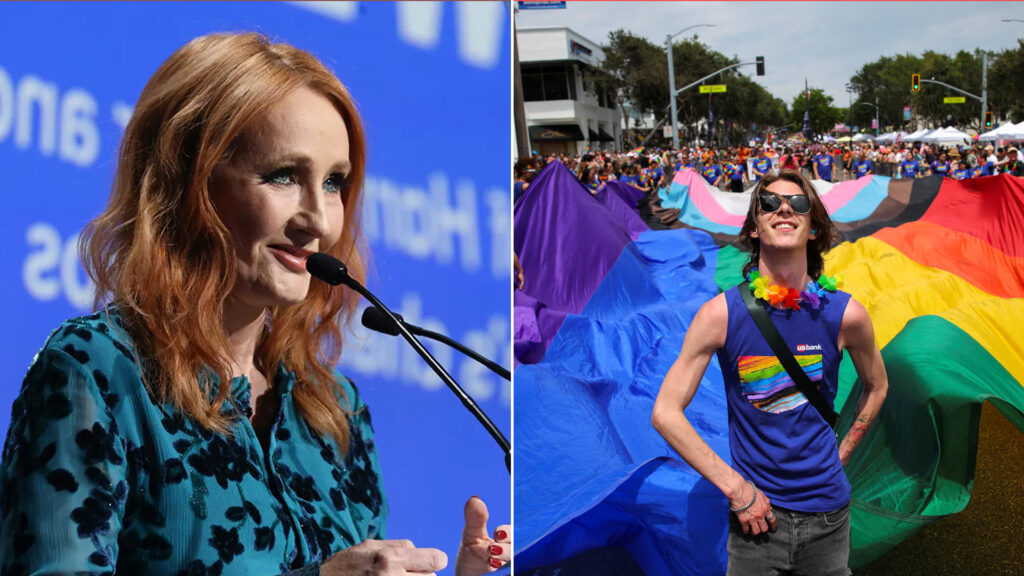
A new debate is gaining traction online after comments linked to J.K. Rowling began circulating in connection with the recent “No Kings Day” protests. The discussion is not centered on the protest itself, but rather on a broader question that has emerged alongside it—who exactly is included when people talk about freedom.
According to widely shared posts, Rowling’s remarks have been interpreted as raising the issue of whether ( ) groups should also be part of movements that promote liberty, expression, and equal rights. While the exact context of the comments remains unclear, the reaction has been immediate and divided.
The “No Kings Day” protests were originally framed as a stand against authority and a call for individual freedoms. Demonstrations took place in multiple locations, with participants emphasizing themes like independence, rights, and resistance to centralized power. However, as with many modern protests, the conversation has quickly expanded beyond its original focus.
Now, attention has shifted toward the question of inclusion.
Supporters of broader interpretation argue that any movement built around the idea of freedom should naturally extend to all communities. From this perspective, excluding certain groups—intentionally or not—creates a contradiction within the message itself. They believe that if the goal is true freedom, it must apply universally.
This line of thinking has fueled much of the online discussion.
Many users have pointed out that modern social movements are increasingly interconnected. Issues of identity, rights, and representation often overlap, making it difficult to separate one cause from another. In that context, calls to include ( ) groups are being seen by some as a logical extension of the protest’s core message.
At the same time, not everyone agrees.
Critics argue that expanding the scope of a protest too far can dilute its original purpose. They suggest that movements are often more effective when they stay focused on specific goals, rather than attempting to address multiple issues at once. For them, the concern is not about exclusion, but about clarity.
This difference in perspective has created a noticeable divide.
On one side, there are those who see inclusion as essential to the credibility of any movement centered on freedom. On the other, there are those who believe that each issue should be addressed within its own space, without merging into a single, broader narrative.
Rowling’s name has added another layer to the situation.
As a public figure who has previously been involved in discussions around identity and social issues, any comments associated with her tend to attract attention. Whether people agree with her or not, her involvement often amplifies the conversation, bringing more visibility—and more scrutiny—to the topic.
In this case, that visibility has turned a relatively straightforward protest into a more complex debate.
Social media has played a significant role in shaping how the story is being interpreted. Short statements, partial quotes, and user-generated commentary have all contributed to a fast-moving narrative that continues to evolve. As a result, different versions of the story are circulating at the same time, each influencing how people understand the situation.
This environment makes it difficult to separate confirmed information from interpretation.
What is clear, however, is that the discussion is no longer just about “No Kings Day.” It has become a reflection of a larger issue—how modern movements define inclusion and where they draw boundaries.
For some, the answer is simple: freedom should mean freedom for everyone. For others, the answer is more complicated, involving questions of focus, purpose, and strategy.
These kinds of debates are becoming more common.
As social and political issues continue to overlap, movements are increasingly being asked to address multiple concerns at once. This creates both opportunities and challenges. On one hand, it allows for broader coalitions and shared goals. On the other, it can lead to disagreements about priorities and direction.
The reaction to the current situation reflects that reality.
Public opinion remains divided, with strong arguments on both sides. Some see the conversation as necessary and overdue, while others view it as a distraction from the protest’s original intent.
At this stage, there is no single conclusion.
The discussion is still unfolding, shaped by ongoing reactions, interpretations, and new information. What began as a protest has now become part of a larger conversation about representation, inclusion, and the meaning of freedom in a modern context.
And as that conversation continues, it highlights a key challenge facing many movements today—how to stay true to their message while also responding to the expectations of an increasingly diverse and vocal public.
Whether this leads to greater unity or further division remains to be seen.
But for now, one thing is certain: the debate is far from over.