
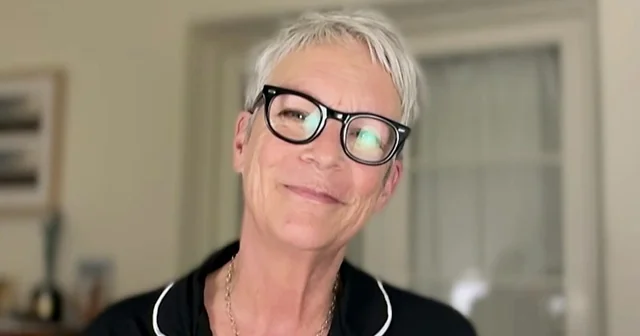
Hollywood actress Jamie Lee Curtis has once again drawn national attention after appearing in a shirt reading “No Kings in America” while encouraging people to take part in the growing “No Kings” marches across the United States.
The moment quickly went viral, with images and clips spreading widely on social media. While the message itself was simple, the reaction has been mixed, turning Curtis’s appearance into part of a broader discussion about PROTESTS, PUBLIC INFLUENCE, and POLITICAL EXPRESSION.
The phrase “No Kings in America” carries a strong historical meaning, rooted in the country’s founding idea of rejecting monarchy and centralized authority. In today’s context, however, the message is being interpreted in different ways. For some, it represents a stand against perceived overreach in leadership, while for others it’s simply a reminder of DEMOCRATIC VALUES and CIVIC FREEDOM.
Curtis didn’t just wear the message—she also encouraged people to participate in the marches. That move has amplified attention toward the protests, bringing them into mainstream conversation and reaching audiences who may not have been following the movement closely.
Public reaction has been sharply divided.
Supporters have praised Curtis for using her platform to highlight what they see as an important issue. They argue that public figures have every right to speak out and that encouraging CIVIC PARTICIPATION is a positive step. Many also point out that her message is broad and not tied to any specific political party, focusing instead on general concerns about POWER and ACCOUNTABILITY.
On the other hand, critics have raised questions about the role of celebrities in political discussions. Some believe that figures from the entertainment industry should avoid encouraging participation in protests, arguing that their influence can shape opinions without full context. Others feel that slogans like “No Kings” can be vague and open to interpretation, which can lead to confusion about what the movement actually stands for.
This situation highlights an ongoing debate about CELEBRITY INVOLVEMENT IN POLITICS.
In recent years, more public figures have used their visibility to express opinions on social and political issues. While this can bring attention to certain causes, it also raises concerns about influence and messaging. Curtis’s appearance is another example of how quickly a public figure can become part of a larger national conversation.
At the same time, the “No Kings” PROTESTS themselves are gaining momentum.
Demonstrations have been reported in multiple areas, with participants focusing on themes such as FREEDOM, GOVERNANCE, and LIMITS OF AUTHORITY. However, the movement does not appear to have a single unified message, which has led to different interpretations depending on who is involved.
Curtis’s involvement has increased visibility, but it has also added complexity to how the protests are being perceived.
Another key factor in this situation is how information spreads online. Social media plays a major role in shaping narratives, often turning a single image or statement into a nationwide discussion within hours. In this case, the image of Curtis wearing the shirt has become a central talking point, even more than the details of the protests themselves.
This reflects a larger trend in modern media, where VISUAL MESSAGING can sometimes have more impact than detailed explanations.
For many people, the shirt represents a clear and direct statement. For others, it raises questions about intent, meaning, and political positioning. This difference in interpretation is what continues to drive the conversation forward.
Despite the mixed reactions, one thing is clear: the discussion is not slowing down.
Curtis’s appearance has added fuel to an already active debate about protests, influence, and how messages are communicated in today’s environment. Whether people see her actions as a positive contribution or an unnecessary вмешment depends largely on their own perspective.
As the “No Kings” MOVEMENT continues to evolve, it is likely that more public figures will become involved, further expanding the conversation. Each new voice adds another layer, making the overall narrative more complex.
For now, Jamie Lee Curtis remains at the center of that conversation—not because of a speech or a policy proposal, but because of a simple message displayed on a shirt.
And in today’s media landscape, sometimes that’s all it takes to spark a national discussion.