
The claim has been repeated so often, it almost feels like fact.
But what if the reality is far more complicated—and far less dramatic than people think?
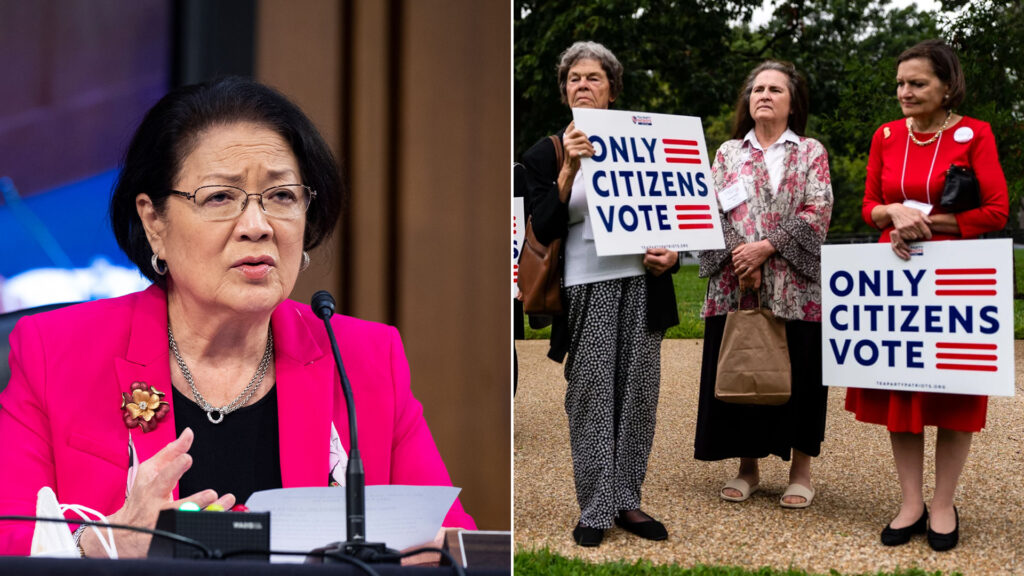
In the middle of America’s ongoing debate over immigration and election integrity, Senator Mazie Hirono has stepped forward with a statement that’s cutting through the noise. Her message is simple, direct, and already stirring conversation across both sides of the political divide.
Undocumented immigrants, she says, wouldn’t dare vote.
Not because they can’t—but because they know exactly what’s at stake.
“It’s against the law,” Hirono emphasized, pushing back against a narrative that has fueled headlines, social media arguments, and political campaigns for years. For her, the issue isn’t about widespread abuse of the system—it’s about fear, risk, and consequences.
And those consequences are real.
In the United States, voting as a non-citizen in federal elections is illegal. The penalties aren’t minor—they can include fines, deportation, and permanent bans from re-entering the country. For someone already living in a fragile legal situation, the idea of taking that kind of risk isn’t just unlikely—it’s irrational.
That’s the core of Hirono’s argument.
People who are undocumented, she suggests, are often hyper-aware of the law, not careless about it. They live with the reality of enforcement every day. The idea that large numbers would suddenly risk everything to cast a single vote doesn’t align with that reality.
But not everyone agrees.
Critics argue that even isolated cases matter. They point to the importance of protecting election systems at every level, insisting that safeguards are necessary regardless of how rare violations might be. For them, the concern isn’t just about numbers—it’s about trust.
And trust, right now, is in short supply.
The debate has become less about data and more about perception. On one side, there’s a belief that the system is vulnerable. On the other, there’s a push to ground the conversation in evidence and legal reality. Hirono’s statement lands squarely in the middle of that tension.
It challenges a widely circulated idea—and that’s why it’s gaining attention.
Because it forces a different question: if the risk is so high, why would someone take it?
Supporters of Hirono say that’s exactly the point. The narrative of widespread illegal voting, they argue, often overlooks the lived experience of undocumented individuals—people who are navigating a system where even minor infractions can have life-altering consequences.
From that perspective, the idea of “daring” to vote isn’t just unlikely—it’s almost unimaginable.
Still, the conversation isn’t going away anytime soon.
Election integrity remains one of the most charged topics in American politics, and immigration continues to sit at the center of it. Statements like Hirono’s don’t end the debate—they reshape it. They shift the focus from fear to logic, from assumption to scrutiny.
And in doing so, they provoke a reaction.
Because in today’s climate, even a straightforward claim can feel controversial.
Whether people see her remarks as common sense or dismiss them as overly optimistic often depends on where they already stand. That’s the nature of the issue—it’s not just about facts, but about belief.
For now, Hirono’s words are adding a new layer to an already complex discussion.
Not louder. Not more dramatic.
Just sharper.
And sometimes, that’s what makes all the difference.