
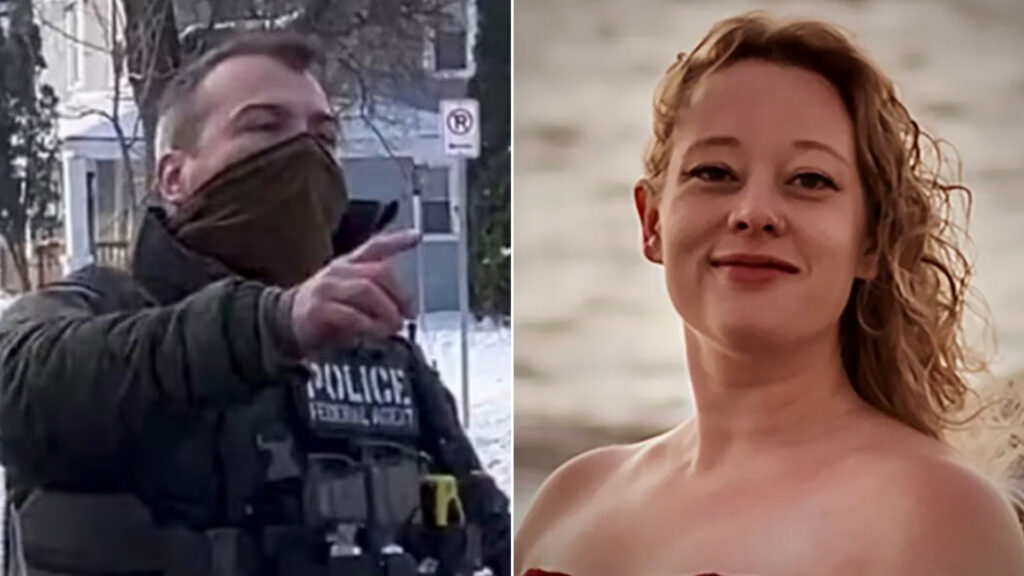
The case involving the fatal shooting of Renee Good is once again gaining attention, as new reports suggest that the ICE agent involved could REPORTEDLY face criminal charges. While no official confirmation has been issued, the development has already sparked intense debate across social media and political circles.
According to circulating updates, the incident remains under active INVESTIGATION, with authorities reviewing the circumstances surrounding the shooting. The lack of a final legal decision has not stopped public reaction from growing, especially as discussions around accountability continue to intensify.
At the center of the controversy is a key question: whether the actions taken by the agent will meet the legal threshold for criminal charges. So far, officials have not publicly confirmed any charges, and sources emphasize that the situation is still being evaluated. Despite this, the idea that charges could be filed has quickly gained traction online.
Supporters of potential legal action argue that this case represents a broader issue involving law enforcement accountability. For them, the possibility of charges signals a step toward justice. Many believe that incidents involving the use of deadly force should always be examined carefully, with full transparency and clear consequences if wrongdoing is found.
On the other hand, critics urge caution, pointing out that early reports can often be incomplete or misleading. They stress that any decision must be based on verified evidence rather than public pressure. From this perspective, the emphasis remains on due process and ensuring that conclusions are not drawn before the INVESTIGATION is complete.
The situation has also been shaped by how information spreads online. Claims marked as REPORTEDLY can quickly turn into widely accepted narratives, even when official confirmation is still pending. This has added another layer of complexity to the case, as public opinion continues to form in real time.
Another important factor is the role of ALLEGATIONS versus confirmed facts. While the shooting itself is not disputed, the legal interpretation of the agent’s actions is still under review. Determining whether those actions were justified or criminal involves a detailed examination of evidence, procedures, and use-of-force guidelines.
Cases like this often highlight the tension between public expectation and legal reality. Many people expect swift accountability, especially in incidents involving loss of life. However, legal processes are typically slow and methodical, requiring investigators to gather facts, interview witnesses, and analyze all available information before reaching a conclusion.
This gap between expectation and process can lead to frustration.
In this case, the emotional weight of the situation has contributed to strong reactions. The death of Renee Good has become a focal point for wider discussions about law enforcement practices, government authority, and public trust. As a result, the case is no longer just about a single incident—it has become part of a larger conversation.
At the same time, the uncertainty surrounding the outcome remains significant.
Officials have not provided a clear timeline for when the INVESTIGATION will conclude, and it is still unclear whether charges will actually be filed. This leaves the situation open-ended, with ongoing speculation continuing to drive attention.
Legal experts often note that the phrase REPORTEDLY COULD FACE CHARGES reflects possibility rather than certainty. It indicates that discussions may be happening behind the scenes, but it does not guarantee a specific outcome. Understanding this distinction is critical, especially in cases where public perception can influence how information is interpreted.
Despite the uncertainty, the case continues to gain visibility.
Public reactions remain divided. Some see the possibility of charges as overdue accountability, while others believe the situation requires more careful evaluation before any conclusions are reached. Both perspectives are contributing to an ongoing debate that shows no sign of slowing down.
As more details emerge, the focus will likely remain on the findings of the INVESTIGATION and whether they support any formal legal action. Until then, much of the discussion will continue to be shaped by REPORTED CLAIMS, interpretations, and evolving narratives.
For now, one thing is clear: the case has become a significant point of discussion, raising questions about justice, responsibility, and how such incidents are handled.
Whether the agent will actually face charges remains uncertain.
But the conversation surrounding the case is already well underway—and it is not likely to fade anytime soon.