
Artificial intelligence has spent the past few years moving at breathtaking speed. New models arrived one after another, companies poured billions into computing infrastructure, and the technology rapidly moved from research labs into offices, schools, smartphones, search engines, and everyday life.
But the conversation surrounding AI is changing.
Some of the most influential figures in the industry are increasingly talking not only about making artificial intelligence more powerful, but also about what happens when those systems become powerful enough to create risks that society is not prepared to handle.
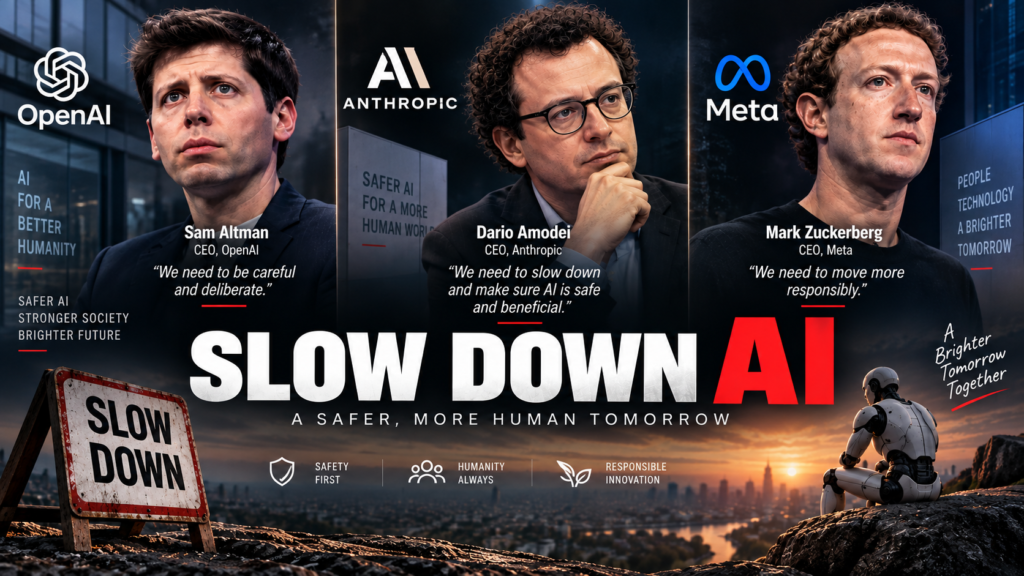
OpenAI CEO Sam Altman, Anthropic CEO Dario Amodei, and Meta CEO Mark Zuckerberg represent three of the most important forces shaping modern AI. Their companies are competitors, and their philosophies are far from identical. Yet the broader debate surrounding all three points toward the same difficult question:
How fast should humanity move?
OpenAI helped ignite the current generative-AI boom with ChatGPT. Since then, Altman has repeatedly discussed the enormous potential of increasingly capable AI while also acknowledging that advanced systems require serious safeguards.
That creates an unusual tension.
The company building some of the world’s most capable AI systems is simultaneously trying to convince governments, businesses, and the public that those systems need to be developed responsibly.
For OpenAI, the challenge is no longer simply making AI smarter. It is making sure increasingly capable systems remain useful, controllable, and aligned with human interests.
Anthropic has made safety an even more central part of its public identity.
Founded by former OpenAI researchers, Anthropic develops the Claude family of AI models and has emphasized research into reliable and controllable artificial intelligence. CEO Dario Amodei has spoken extensively about both the extraordinary benefits advanced AI could create and the potentially serious consequences if increasingly powerful systems are poorly controlled or misused.
That does not necessarily mean stopping AI development.
Instead, the emerging argument is that capability and safety may have to advance together.
If an AI system becomes dramatically more powerful, researchers need equally sophisticated methods for understanding its behavior, restricting dangerous capabilities, preventing misuse, and ensuring humans remain in control.
Then there is Meta.
Mark Zuckerberg has pursued a noticeably different strategy, particularly through Meta’s investment in the Llama ecosystem and its support for more openly available AI models. Meta argues that broader access to AI can encourage innovation and prevent a small number of corporations from controlling the technology.
But greater accessibility creates its own debate.
Powerful models can help developers, researchers, entrepreneurs, and ordinary users create things that previously required enormous resources. The same capabilities, however, can potentially be abused.
This leaves the industry balancing openness against security.
And that is why “slow down” should not necessarily be interpreted as “stop AI.”
The real discussion is becoming more complicated.
Artificial intelligence could accelerate scientific discoveries, improve healthcare research, transform education, increase productivity, create new businesses, and give individuals capabilities that once belonged only to large organizations.
At the same time, increasingly capable AI could disrupt employment, amplify misinformation, enable sophisticated cyberattacks, concentrate economic power, and create entirely new categories of risk.
The faster the technology develops, the less time governments and institutions have to adapt.
Regulation traditionally moves slowly. AI does not.
A law can take years to negotiate and implement. A new AI model can be trained, released, and adopted by millions of people within months.
That mismatch is becoming one of the defining problems of the AI era.
There is also a competitive dilemma.
Imagine one company deciding that its next system is too powerful to release without another year of safety testing. If competitors continue moving ahead, the cautious company risks losing users, investment, talent, and market position.
Every company therefore has an incentive to keep racing—even when executives recognize reasons to be careful.
The same problem exists between countries.
No major technological power wants to slow its AI development if it believes another country will continue accelerating.
That means meaningful AI safety cannot depend entirely on voluntary promises from individual CEOs. It may eventually require shared technical standards, independent evaluations, stronger security practices, international cooperation, and carefully designed regulation.
The goal should not be to destroy innovation.
It should be to make progress sustainable.
Humanity has rarely encountered a technology capable of improving itself indirectly through research, coding, automation, and massive computational scale at anything resembling the pace now being discussed.
That makes AI different from an ordinary technology race.
The biggest question may soon stop being which company has the smartest model.
It may become whether the institutions surrounding those models can evolve quickly enough to manage them.
OpenAI, Anthropic, Meta, and their competitors are still pushing forward. The AI race has not stopped.
But the conversation is maturing.
Speed created the AI revolution.
Responsibility may determine what happens next.